Questioning the EU
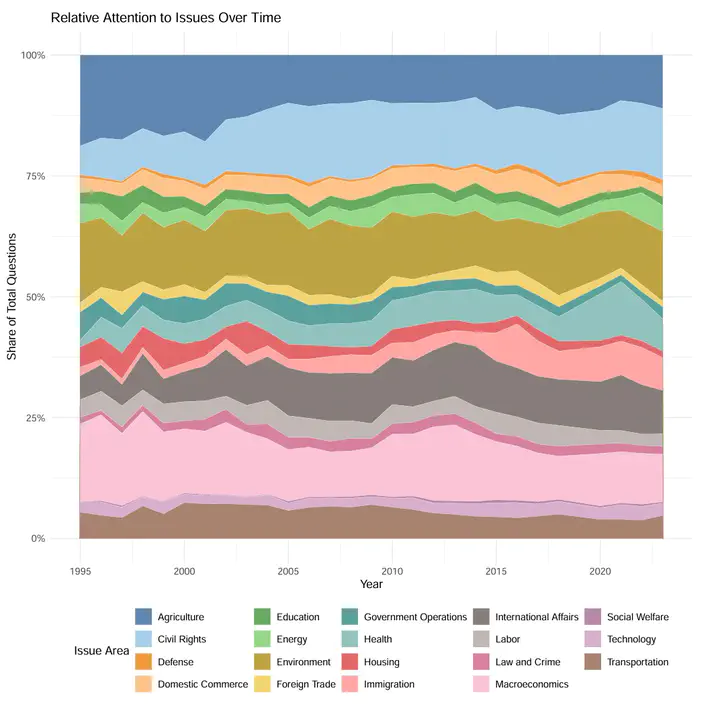 xxx
xxx
EUQuest investigates how Members of the European Parliament (MEPs) engage with policy issues, and what their behaviour reveals about the broader dynamics of political conflict and representation in the European Union. As the Parliament has grown in power and visibility over recent decades, understanding what issues MEPs prioritise – and why – has become essential to grasp how European politics works today.
The project builds the first comprehensive dataset of all written parliamentary questions submitted in the European Parliament, which we coded by policy content using advanced computational methods including large language models and fine-tuned open-source AI. We have already coded questions for the period between 1994 and 2024 – over 180,000 texts - and we are currently going back to 1979.
By analysing these questions, EUQuest sheds new light on how issues rise and fall on the EU agenda, how national and partisan interests shape MEPs’ activities, and how individual characteristics influence their policy focus.
Beyond mapping patterns of politicisation and issue competition, EUQuest aims to improve our understanding of how the European Parliament represents citizens’ concerns and responds to changing political challenges.
The project is supported by the PRIN 2022 grant Questioning the EU (EUQuest). I am the PI of the project and of the central research Unit at the University of Catania, where my colleague Stefania Panebianco is also involved. A lot of students collaborate to this project within the EuDARe Lab. Federico Russo coordinates the other research unit set up at Salento University.
This is a 2022 PRIN project funded under the National Recovery and Resilience Plan (NRRP), Mission 4 Component 1, funded in turn by the European Union – NextGenerationEU. The full name of the project is Questioning the EU. Politicisation, representation, and agenda setting in the European Parliament (EUQuest), CUP E53D23006720006.
The EuQuest website will be online soon!
Marcello Carammia
Associate Professor in Political Science
My research focuses on the comparative analysis of institutions and public policies, with special interest in the interaction between migration dynamics, politics, and policy.